This competence approach is a structured process that encompasses the definition, development and assessment of competences acquired during training. The concept of competence adopted is based on the combination and mobilization of several disciplinary resources (knowledge and know-how), enabling students to act effectively in different contexts. Thus a skill is assessed according to the level of effectiveness of the mobilization of resources in situations, known as propitious, constructed for this purpose.
The acquisition of these savoir-agir is facilitated by feedback to students, so that progress can be observed and consolidated.
Centrale Lyon is committed to rigorously evaluating the acquisition of its students' skills by regularly assessing them with grades ranging from A to F. In parallel, so-called disciplinary resources are always assessed with a grade out of 20. These two complementary modes of assessment enable us to fully characterize each student's journey through the school.
Skills observed
The general engineering training from Centrale Lyon includes five essential skills, developed in collaboration with experts from the business world. This reference system is common to all the schools in the Centrale Schools Group.
To assess each skill, it is necessary to define the expected actions, i.e. what will be observed in a given situation: these are the observable components of the skill. Each skill in the reference framework is broken down into three observable components.
- Emerge and innovate
- Operate and undertake
- Create and create value
- Representing and modeling complex systems
- Solving problems and discussing the validity of models
- Thinking and acting in unpredictable and uncertain environments
- Designing a project or program
- Piloting and managing actions
- Closing and capitalizing on experience
- Getting to know and build yourself
- Generating performance, both individual and collective
- Leading transformations within an organization
.
- Anticipating and committing
- Giving meaning
- Building and sustaining
Skills assessment and development paths
For each of the 15 observable components, a development pathway in 5 levels - novice, intermediate, proficient, advanced and expert - has been defined. To graduate, students must reach the third level, known as "proficient".
The following levels can be reached over the course of a professional career, with the expert level requiring 5 to 7 years of practice after graduation. These development paths have been drawn up with the help of experts from the business world.
During their time at the school, at each level, students' skills are assessed using three letter grades:
- A for "outstanding"
- C for "acquired"
- F for "to work on"
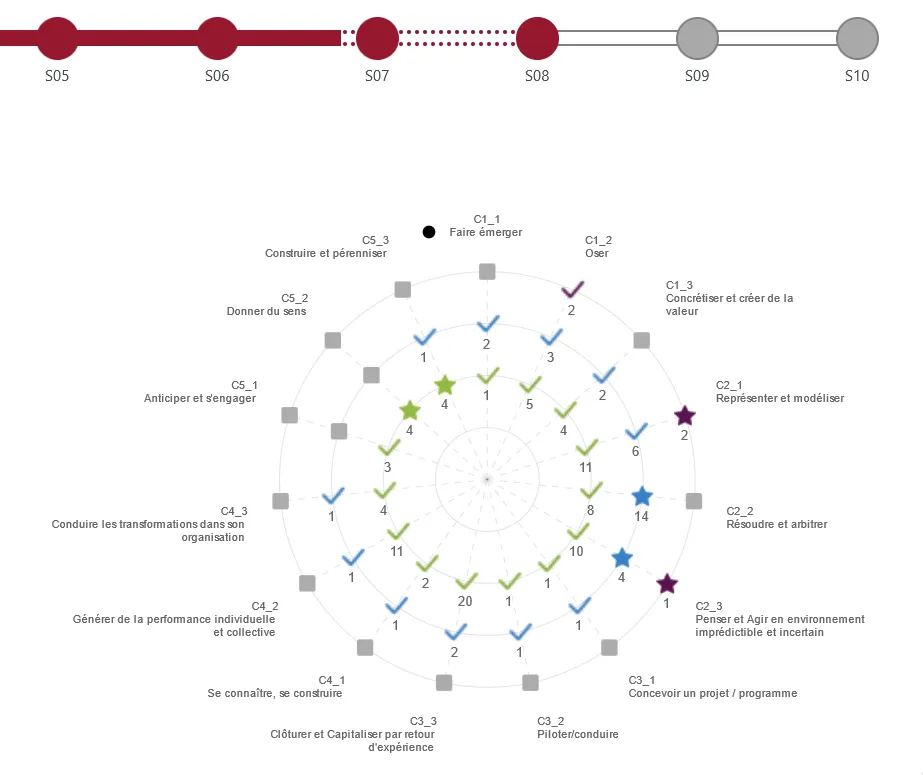
A unique, dedicated platform
Centrale Lyon has developed a unique application of its kind to track and support the acquisition of skills by each student.
This platform, accessible online, offers a real-time view of the cross-disciplinary skills mobilized and observed in each training action.
It also enables students totrack their progressand to obtain an individualized certificate in the form of a diploma supplement.
A customized diploma supplement
As part of the competency approach, Centrale Lyon now issues each generalist engineer a diploma supplement corresponding to their competency profile. This individualized document highlights the major cross-disciplinary skills developed by the student during his or her career, among the 15 components of the reference system such as posing, anticipating and committing, thinking in an uncertain environment, leading transformations, capitalizing through feedback....
This supplement constitutes a differentiating asset for professional insertion. It enables recruiters to identify the strengths of each graduate engineer and distinguish profiles beyond the academic level alone.
It also testifies to Centrale Lyon's commitment to offering quality training that fully integrates contemporary business issues. Throughout their curriculum, engineering students are regularly involved in concrete, professionalizing projects: industrial assignments proposed by partner companies, engineering projects integrating societal and environmental issues as part of collective simulations, or participation in weeks dedicated to innovation around real issues brought forward by institutional and private players.
This diploma supplement is also being rolled out to the institution's specialty engineering courses and bachelor of science in Data Science.