Each year, the Institut universitaire de France appoints junior (under 42) and senior lecturers and researchers, for a period of five years. The successful candidates remain attached to their home institution, on secondment. The Institute funds a reduction in part of their teaching duties and pays them an annual grant for their research.
From engineering students to industrial partners
Gaylord Guillonneau teaches materials science and mechanics to engineering students at Centrale Lyon. Since 2024, he has also been in charge of the materials science programme for work-study students. Five doctoral theses he has supervised have been successfully defended, and four are currently in progress. In 2022, his PhD student Gabrielle Tiphéne received the award for the best doctoral oral presentation at the Nanomechanical Testing in Material Research and Development VIII conference in Split (Croatia).
His work has resulted in 40 publications in international peer-reviewed journals and one patent. He is currently the principal investigator for the CNDSM 2 project, funded by the i-Démo call for proposals under the France 2030 plan and dedicated to sub-micrometre non-destructive testing. This project brings together, until 2030, the LTDS, Safran, Thales and four other partners.
Measuring surface properties at temperatures above 800 °C
Contacts in industrial mechanical systems wear out over time. To manage this wear and minimise the need to replace parts, it is necessary to understand the mechanical properties of the contacting surfaces under their actual operating conditions. At temperatures above 800 °C, these properties remain difficult to measure reliably, because the chemical environment – which is currently uncontrolled – significantly alters the surface.
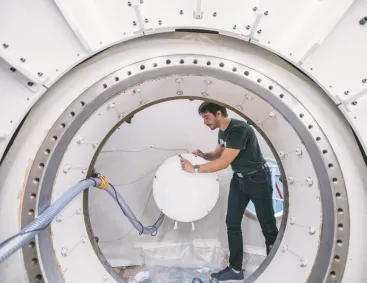
Gaylord Guillonneau’s research chair, ‘Understanding near-surface mechanochemical transformations in a controlled environment’, tackles this challenge. It plans to install a high-temperature nanoindenter from the LTDS in a high-vacuum chamber (a nanoindenter is a device used to measure mechanical properties at the very surface of a material). The vacuum limits surface oxidation, and gases can be introduced to simulate specific environments. Thanks to this appointment, Gaylord Guillonneau intends to continue his work to better understand the mechanical and chemical properties of surfaces under these conditions, in relation to their behaviour in friction and wear.